
Executive Context (Why This Matters Now)
Artificial Intelligence (AI) has crossed a critical threshold. It is no longer an experimental technology or a niche productivity enhancement—it is now the default operating layer for modern business, creativity, and leadership. Whether you are a founder, executive, investor, marketer, creator, or advisor, AI tools such as ChatGPT, generative AI platforms, and large language models (LLMs) are already shaping how you think, communicate, and execute.
What makes this moment unique is not just the power of AI, but the speed at which it has been adopted. In less than two years, AI has gone from curiosity to infrastructure. It now sits inside presentations, white papers, investment memos, marketing campaigns, scripts, emails, and daily decision-making.
This article explores a fundamental paradox of the AI era:
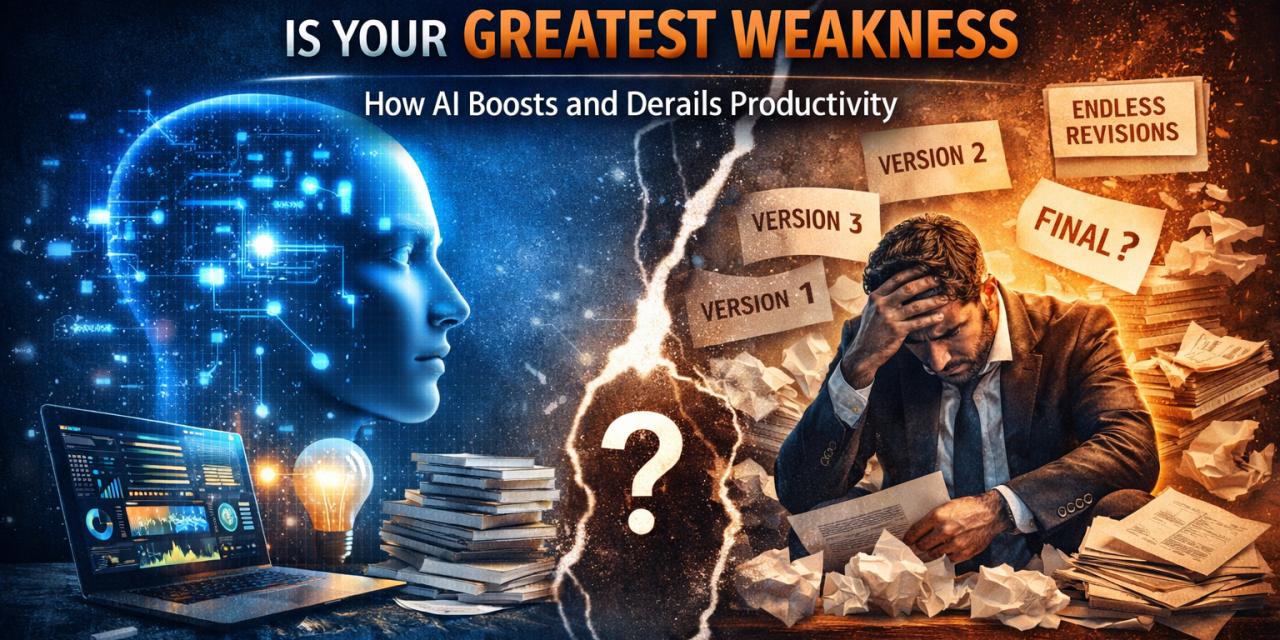
AI is your greatest productivity advantage—and simultaneously your greatest productivity liability.
AI increases velocity, scale, and creative range. At the same time, it introduces new risks: overthinking, overproduction, decision fatigue, and delayed execution. Understanding this duality—and learning how to manage it—is now a core leadership skill.
The Strength: AI as a Productivity and Content Force Multiplier
AI for Presentations and Pitch Decks
Presentations have historically been a bottleneck. They required coordination between strategy, design, messaging, and storytelling. AI has fundamentally changed this process.
Today, AI can:
- Generate full investor pitch decks, sales decks, and board presentations from a simple outline
- Instantly adapt content for different audiences such as angel investors, venture capital, institutional funds, strategic partners, or internal teams
- Improve slide headlines, logical sequencing, and narrative flow
- Translate complex technical or financial ideas into executive-level clarity
What once took days—or weeks—can now be accomplished in a focused session. More importantly, AI allows leaders to stay in conceptual mode rather than getting trapped in formatting or structure. This dramatically improves productivity at the highest levels.
AI for White Papers, Research, and Long-Form Thinking
White papers and research documents have traditionally required teams of analysts, editors, and subject-matter experts. AI now functions as a highly capable research and drafting partner.
AI excels at:
- Structuring white papers, investment theses, and institutional research
- Expanding bullet points into coherent, professional long-form analysis
- Maintaining consistent tone and terminology across long documents
- Translating highly technical concepts into clear, accessible language
This capability has unlocked thought leadership at scale. Founders and executives are no longer limited by writing bandwidth. Ideas can now be captured, refined, and shared while they are still fresh.
AI for Content Creation, Marketing, and Brand Voice
AI has removed one of the greatest historical constraints: the blank page.
Today, AI supports:
- Articles, blogs, newsletters, and opinion pieces
- Social media content for LinkedIn, X, Medium, and newsletters
- Video scripts, podcast outlines, and keynote speeches
- Repurposing long-form content into short-form assets
This means one strong idea can now power an entire content ecosystem. Used correctly, AI allows leaders to show up consistently without sacrificing quality or authenticity.
AI as a Thought Partner and Clarifier
Perhaps AI’s most underappreciated strength is its role as a thinking companion.
AI continuously asks clarifying questions:
- Do you want this more strategic or tactical?
- Is this for investors, customers, or internal teams?
- Should this be visionary or conservative?
- Would you like alternative positioning?
These prompts force reflection. They surface assumptions. They sharpen intent. In this way, AI does not just produce content—it improves thinking.
The Weakness: When AI Productivity Turns Into Noise
The Infinite Iteration Trap
AI never gets tired. It never runs out of alternatives. And it never knows when enough is enough.
AI will happily generate:
- Multiple versions of the same document
- Endless refinements in tone, length, and structure
- Variations for every conceivable audience
At first, this feels empowering. Over time, it becomes paralyzing. The abundance of choice erodes decisiveness.
The Illusion of Progress
AI output feels productive. Documents grow. Slides multiply. Content expands.
But output is not outcome.
Without discipline, AI enables what looks like work but produces no real-world result. This is productivity theater—motion without momentum.
When Abundance Undermines Execution
Before AI, constraints forced decisions. Limited time and resources required prioritization.
AI removes those constraints. And with them, urgency.
AI will never say:
- This is good enough.
- Stop refining.
- Launch now.
Only humans can make that call.
Creative Constraints: The Missing Discipline in the AI Era
The highest performers do not succeed because they have more options. They succeed because they impose intentional constraints.
Creative constraints include:
- Fixed time limits
- Word or slide caps
- Predefined iteration counts
- Single audience focus
- One primary objective per asset
Constraints transform AI from a source of distraction into a precision instrument.
Knowing When to Stop—and Ship
AI encourages perfection. Markets reward presence.
There will always be another version. Another improvement. Another refinement.
Momentum is created by decisions, not drafts.
At some point, you must choose a version and move forward. Execution is where learning actually happens.
Staying focused is important. Here are some actionable steps to help along the way.
Ten Rules for Using AI Without Losing Productivity
- Start with the outcome, not the tool – Define success before engaging AI.
2. Limit iterations upfront – Decide how many versions are allowed.
3. Time-box AI usage – Prevent wandering refinement.
4. Assign AI a role – Analyst, editor, strategist, or copywriter.
5. Optimize one variable per pass – Tone, length, or audience—not all at once.
6. Lock the core narrative early – Refine delivery, not direction.
7. Clearly label the final version – Eliminate confusion.
8. Publish before comfort arrives – Discomfort signals readiness.
9. Use AI to accelerate decisions – Not to avoid them.
10. Remember: you are the editor-in-chief – Judgment remains human.
The Human Advantage in an AI-Driven World
AI amplifies behavior.
- Lack clarity? AI magnifies confusion.
- Lack discipline? AI magnifies distraction.
- Lack conviction? AI magnifies indecision.
But when paired with vision, constraints, and judgment, AI becomes an extraordinary ally.
Final Thought
Your greatest strength—AI’s speed, scale, and intelligence—can quietly become your greatest weakness.
The leaders who win in the AI era will not be those who create the most content, but those who:
- Decide faster
- Ship sooner
- Iterate in the market, not endlessly in drafts
That discipline is not artificial.
It is human.


