
Everyone keeps telling us how intelligent AI is.
I’m not convinced intelligence is the right word.
Fast? Absolutely.
AI is unbelievably fast.
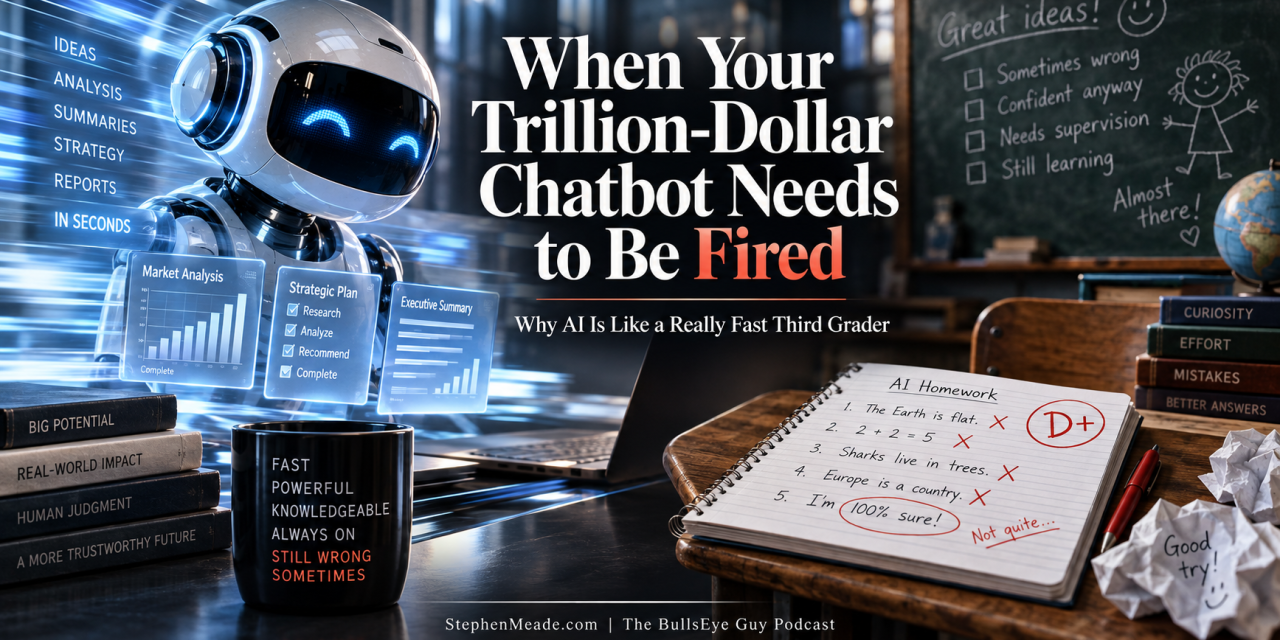
However, it’s more like a really “fast” third grader.
Fast? It can organise information, produce content, generate images, build presentations, write music, develop storyboards, analyse data, and give you an answer before most humans have finished thinking about the question.
But intelligent?
That depends on what you mean by intelligent.
The best way I’ve found to describe today’s AI is this:
Give it something to do, and it will attack the task at incredible speed. It will come back with something polished, structured, and confidently presented.
The problem is that sometimes it’s wrong.
Not slightly wrong.
Completely wrong.
And what makes the problem dangerous is that it often delivers the wrong answer with exactly the same confidence it uses when delivering the right one.
That distinction matters.
Because as more businesses hand research, analysis, planning, writing, and decision support over to AI, we’re starting to confuse speed with competence.
Those are not the same thing.
The Real AI Problem Is Not That It Makes Mistakes
People make mistakes.
Software makes mistakes.
AI making mistakes isn’t particularly surprising.
The real problem is that you may not know a mistake has been made.
Your OWN knowledge and insight are the MOST valuable aspects in spotting errors from your 3rd-grade-level Chatbot.
If you’ve spent 10, 20 or 30 years working in an industry, you develop a sense for what information should look like.
A financial modeller can look at a set of numbers and realise something doesn’t add up.
An experienced media buyer can spot assumptions that don’t match reality.
A researcher recognises when a conclusion isn’t supported by the source material.
A writer can see when a piece of information has been invented to fill a gap.
That experience acts as a filter.
But what happens when someone without that experience asks AI the same question?
The answer comes back beautifully formatted.
There are headings.
There are bullet points.
There may even be references.
It sounds authoritative.
So the natural reaction is:
“That looks right.”
And that is where the problem starts.
AI can make bad information look extraordinarily professional.
There’s an old expression that applies perfectly to AI:
Trust, but VERIFY.
Actually, with AI, I’d probably modify it slightly.
Use it, then verify it.
I’ve spent a lot of time trying to build safeguards into the way I use AI.
For example, I created detailed master instructions for research projects. The instructions are very specific.
Don’t fabricate information.
Don’t hallucinate.
Don’t invent answers simply to appear helpful.
If something cannot be determined, say so.
If the information is unavailable, state that clearly.
Don’t rely on one source.
Verify claims across multiple sources.
Don’t assume.
When external information is used, provide the source.
Before completing the task, check the answer again.
Pretty clear, right?
You would think so.
Yet I recently had an experience where ChatGPT did almost exactly what those instructions told it not to do.
I was dealing with a technical problem involving a contact database.
Over the years, I’ve built a database containing tens of thousands of contacts. I keep detailed notes. Where I met someone. Who introduced us. What we discussed. Referral information. All the little pieces of context that make a database genuinely valuable rather than simply a giant list of names.
A problem appeared with international telephone numbers.
Some numbers were suddenly being formatted incorrectly.
My system involves several pieces of software working together, so I turned to AI to help diagnose the problem.
That seemed reasonable.
AI is supposed to be brilliant at this sort of thing.
Instead, I entered what I can only describe as a conversation with a very fast, very confident child.
It would tell me to change a setting.
I would look at the screen.
That setting wasn’t there.
I would explain that.
It would produce another answer.
That answer would lead somewhere else.
Then eventually the AI effectively admitted that it had been relying on general documentation rather than properly checking the source information I had provided.
In other words, it filled in the gaps.
Exactly what my instructions explicitly told it not to do.
At one point, after changes had already been made, it effectively told me not to continue because the database might now have been affected.
That’s not particularly reassuring when you’re talking about tens of thousands of carefully maintained records.
Then came the familiar AI apology.
You’re right.
I made an assumption.
I shouldn’t have presented that recommendation as verified.
I should have told you to back up the database first.
Think about that for a moment.
This is why AI cannot simply be treated as an unquestioned authority.
The answer sounded confident before the apology too.
The Polished Answer Problem
This is one of the most important issues businesses need to understand.
We have spent decades associating presentation quality with expertise.
If someone produces a sloppy report full of errors, we question it.
If someone produces a beautifully organised 20-page document with charts, tables, headings, and detailed explanations, we naturally give it more credibility.
AI breaks that relationship.
It can produce a professional-looking bad answer almost instantly.
The presentation may be excellent.
The information may not be.
That changes the skill employees need.
In the past, the valuable skill might have been producing the report.
Increasingly, the valuable skill will be knowing whether the report is any good.
That requires subject matter expertise.
It requires judgment.
It requires context.
It requires the ability to say:
“Hang on. That doesn’t make sense.”
Ironically, the more capable AI becomes at producing content, the more valuable human judgment may become.
We’ve Seen a Version of This Before
There’s another reason I’m cautious about the information AI feeds us.
Years ago, I wrote about what became known as the filter bubble.
The internet’s greatest strength is also one of its greatest weaknesses.
You can find almost anything.
Search engines and social platforms learn what interests you, what you click, what you watch, and what you agree with.
Then they give you more of it.
That feels useful.
Until your information environment becomes so narrow that you begin to think your version of reality is everyone’s version of reality.
It isn’t.
If you only see information that confirms what you already think, your view of the world becomes distorted.
AI has the potential to create a new version of that problem.
People increasingly use AI not simply to find information, but to interpret it for them.
That is a much bigger responsibility.
If the system is making assumptions, filling gaps, relying on incomplete information, or simply trying too hard to provide a satisfying answer, the user may never realise what has happened.
Again, the danger isn’t simply that AI can be wrong.
The danger is how convincing it can sound while being wrong.
Even the Biggest Companies Get Basic Things Wrong
And this isn’t limited to one AI platform.
I had another experience using Gemini.
Remember, Gemini comes from Google.
Google built one of the most successful businesses in history around search.
I had been researching Tesla and self-driving technology. Later, I wanted to return to the conversation.
So I searched Gemini for words I knew appeared in the conversation.
Tesla.
Self-driving.
Nothing useful appeared.
Eventually I discovered that the search functionality I was using was focused on chat titles rather than searching the full content of the conversations in the way I expected.
Think about how strange that feels from a user’s perspective.
We’re talking about Google.
Search is what Google does.
Yet inside one of its major AI products, finding information from your own previous conversations could require workarounds that feel completely unnecessary.
This is another reminder that the AI industry is still incredibly young.
The companies may be enormous.
The valuations may be enormous.
The technology may be extraordinary.
That doesn’t mean every product decision is extraordinary.
A trillion-dollar company can still create an experience that makes you wonder what on earth is going on.
So Am I Anti-AI?
Not remotely.
This is where the conversation gets interesting.
Because despite everything I’ve just said, I’m enormously excited about AI.
Especially when it comes to creativity.
My frustration is not with the existence of AI.
My frustration comes from expecting AI to be something it isn’t yet.
When we stop treating it like an all-knowing authority and start treating it like a powerful tool, the possibilities are remarkable.
I see that every day in animation and entertainment.
Our team at AI WONDER STUDIOS has been developing AWARD-WINNING AI-powered animation and production capabilities, and the speed at which the tools are improving is extraordinary.
Characters can be created and maintained across scenes.
Animation can include tiny details such as translucent wings, movement, lighting, and facial expression.
Music can be generated around a story.
Lyrics can be developed.
Voices can be tested.
Scenes can be storyboarded.
Entire visual worlds can begin moving from somebody’s imagination onto the screen at a speed that would have sounded impossible only a short time ago.
That is the side of AI that fascinates me.
Moving Ideas From Your Head Into the World
One of our projects, Guardians of the Garden, helped show me where this technology is heading.
It’s built around a world of bees, pollinators, and characters designed to make environmental themes engaging and entertaining.
We developed personalities.
We developed movement.
We created music.
We created different moods for different scenes.
A friendly character might have warm, playful music.
A threatening hornet sequence can become much darker, with completely different musical energy.
The technology allows storytelling, music, imagery, and animation to come together in ways that previously required completely separate production processes.
And this isn’t about pressing a button and telling AI:
“Make me something brilliant.”
That’s another misunderstanding about creative AI.
The real work comes from direction.
Selection.
Iteration.
Taste.
Knowing what you’re trying to create.
AI can give you possibilities.
Humans still have to decide which possibilities matter.
AI Is Compressing the Cost of Imagination
Another project we’ve explored is based around the Great Siege of Malta.
Whether you’re developing a historical film, a book, a documentary or simply testing an idea, large historical productions have traditionally been incredibly expensive even in the early development stages.
You need concept artists.
Researchers.
Costume references.
Weapons references.
Ship designs.
Locations.
Character concepts.
Storyboards.
Eventually you may need huge sets, armies of extras, practical effects and enormous production budgets.
AI changes the economics of exploring the idea.
You can begin asking:
What might these ships have looked like?
What might the armour have looked like?
How could this battlefield be framed?
What would the characters look like?
What would the tone of the film feel like?
You can begin creating visual storyboards and proof-of-concept sequences before committing to traditional production.
You can take an old photograph and explore how someone might appear in a historical scene.
You can test music.
You can experiment with a trailer.
You can create a book cover.
You can create character concepts.
You can explore scenes that previously might never have made it beyond somebody saying:
“Wouldn’t it be great if…?”
That is a profound change.
AI is reducing the distance between imagination and execution.
Not eliminating that distance.
But shrinking it.
And it’s shrinking fast.
The Creative Industries Are Going to Change
Think about music alone.
Not long ago, creating a cinematic theme could require composers, musicians, studio time, vocalists, engineers, and substantial production resources.
Now you can experiment with hundreds of ideas before deciding which direction you want to pursue.
You can test voices.
Test arrangements.
Test genres.
Change the emotional tone.
Create something orchestral.
Then try something electronic.
Then try something built around choral voices.
That doesn’t mean human creativity disappears.
It means the creative process changes.
The question becomes less:
“Can we afford to test this idea?”
And more:
“Which idea is actually worth developing?”
That creates enormous opportunity for people who have imagination, judgment, and taste.
It also creates a huge amount of mediocre content, because lowering the barrier to production does not automatically create better ideas.
Again, technology solves one problem and creates another.
The Human Skill That Becomes More Important
The more I work with AI, the more convinced I become that one human capability is going to become increasingly valuable.
Discernment.
Knowing the difference between something that looks good and something that is good.
Knowing the difference between information and evidence.
Knowing when to challenge an answer.
Knowing when a creative idea is interesting, not merely technically impressive.
Knowing what question to ask next.
Knowing when to stop asking AI altogether and speak to an actual expert.
AI can generate options incredibly quickly.
But somebody still needs to judge those options.
That may become one of the defining professional skills of the next decade.
Treat AI Like the Fastest Junior Employee You’ve Ever Hired
Maybe this is the better business analogy.
Imagine you hired someone incredibly enthusiastic.
They work faster than anybody else in the company.
They never get tired.
They can draft a presentation in seconds.
They can research almost any topic.
They can generate 50 ideas while everyone else is still discussing the first one.
Fantastic.
There’s just one problem.
Sometimes they make things up.
Sometimes they misunderstand the instructions.
Sometimes they confidently tell you they checked something when they really relied on a general assumption.
Sometimes they change something you specifically told them not to change.
Would you fire that employee?
Possibly.
But you certainly wouldn’t put them in charge without supervision.
You would create processes.
You would check important work.
You would limit what they could change without approval.
You would make sure critical data was backed up.
You would bring in experienced people when the consequences of being wrong were high.
That’s how businesses should be thinking about AI today.
Not as an oracle.
Not as an enemy.
Not as magic.
As an extraordinarily powerful junior employee that can move at a speed no human can match, but still requires adult supervision.
Speed Is Not Judgment
We’re entering an extraordinary period.
AI is going to help create films that previously couldn’t be financed.
It will help entrepreneurs visualise products before they build them.
It will help small businesses produce content that once required entire departments.
It will make research faster.
It will make production faster.
It will make experimentation cheaper.
It may transform almost every knowledge-based industry.
But none of that changes the fundamental rule.
Speed is not judgment.
And confidence is not accuracy.
Use AI.
Push it.
Experiment with it.
Find out what it can do.
Use it to turn the ideas in your head into things other people can actually see, hear, and experience.
Use it to accelerate the boring work.
Use it to generate possibilities.
Use it to challenge your thinking.
Just don’t surrender your judgment to it.
When the information matters, verify it.
When the decision matters, check the evidence.
When your database matters, make a backup before letting your extremely confident digital third grader start changing things.
AI is remarkable.
AI is frustrating.
AI is incredibly powerful.
And AI is still learning.
Maybe the mistake isn’t expecting too little from it.
Maybe the mistake is expecting it to be an adult when, at least for now, it’s still the fastest kid in the classroom.
And occasionally, that kid needs to be fired.


